We investigate your problem on its own terms first, and let the evidence decide what we build.
Some problems have a proven answer already. Others need something genuinely new. Most sit somewhere in between.
We don't start with a fixed toolkit and look for a place to apply it. We start by understanding your data, your constraints, and what "success" actually needs to look like — then draw on established methods, extend them, or develop something new, in whatever combination the evidence supports. It's the same investigative discipline our research-trained team brings from doctoral-level research, applied to a business timeline.
We evaluate existing tools and methods against your real data first, so any recommendation — build, extend, or integrate — is backed by evidence, not habit.
When your problem sits outside what's already published or productised, our research background lets us develop a genuinely new method rather than force-fit an old one.
Decisions built on AI need to hold up to scrutiny — from your board, your regulator, or your own engineering team.
Every engagement follows the same rigour as peer-reviewed research — compressed into a timeline that works for a business, not a thesis.
We frame the real problem underneath the request — the one worth solving.
We survey and extend the current state of the art against your specific constraints.
We build and test bespoke models directly against your real data, not a demo set.
Rigorous, statistically sound evaluation — results you can defend, not just demo.
We translate validated findings into a working prototype and a clear, evidence-backed roadmap your team can build on.
Every stage produces a written artefact — problem brief, research memo, evaluation report, prototype and roadmap — so nothing lives only in someone's head.
Five ways we typically engage — most projects combine two or three.
Custom models built from first principles when off-the-shelf architectures don't fit your data, constraints, or performance requirements.
A rigorous, evidence-based answer to "is this even possible?" — before you commit engineering budget to finding out the hard way.
Turning scattered, inconsistent, or underused data into a foundation that can actually support AI — and everything else you'll want to build next.
Turning validated research and experimental models into working prototypes and clear, evidence-backed technical roadmaps your team can take forward.
Independent, PhD-level review of AI systems, vendors, or acquisition targets — for investors and executives who need a second, expert opinion.
Most clients start with a 30-minute consultation — we'll tell you honestly if this is an AI problem at all.
Talk to us →A sample of past research and applied projects across sectors. Institutional partners and publication details withheld — full background available on request.
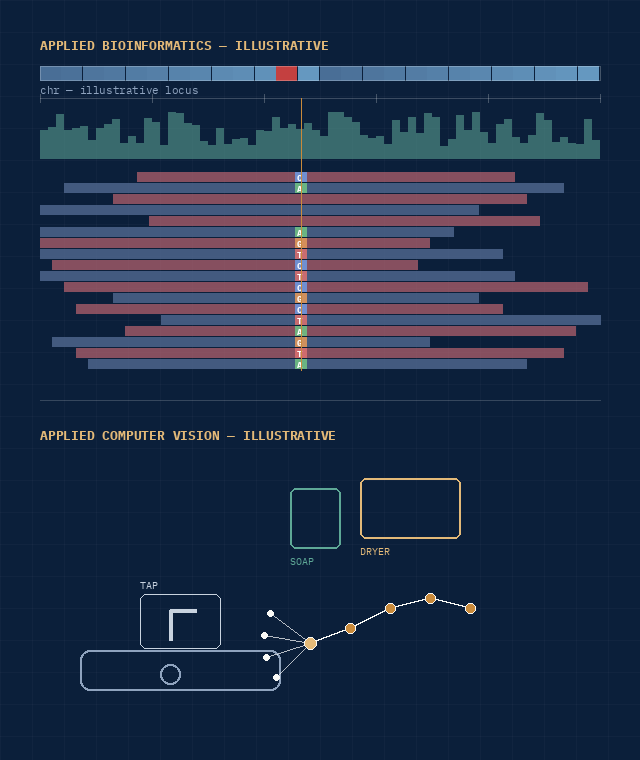
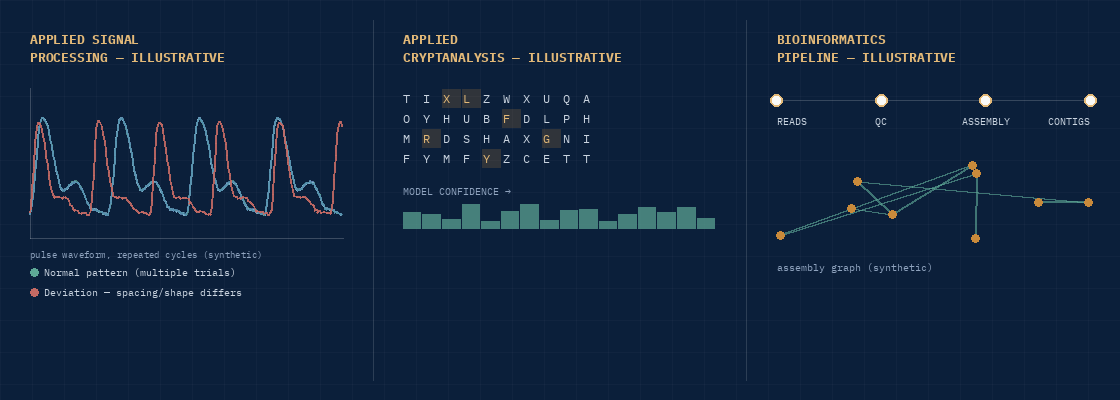
Synthetic visualisations built to illustrate the type of work involved — not derived from client or published data.
Collaborative research applying AI to detect hand hygiene compliance in food production environments, exploring how automated monitoring can support food safety standards in practice.
Applied bioinformatics and AI to genomic data to better understand — and help predict — which common infections are more likely to progress into a rare, life-threatening condition, in partnership with a UK hospital.
A retrospective cohort study examining clinical and radiological factors linked to patient outcomes during the COVID-19 pandemic, conducted with a UK hospital.
Designed and built software adopted at a UK university to reduce administrative load in coursework assessment and flag possible cases of plagiarism — later extended with automated marking for diagrammatic coursework, funded through a university innovation grant.
Re-engineered a legacy case-based reasoning system into a modern, web-based client-server application for a UK telecommunications enterprise, separating business and presentation logic for long-term maintainability.
Improved a risk-scoring model for mining assets by combining Monte Carlo simulation with machine learning-based prediction — replacing a static, rule-based approach with one that reflects real uncertainty in the underlying data. Delivered with an interactive dashboard for configuring model parameters, built on Streamlit and Snowflake.
Built a big-data analytics solution to track and manage the lifecycle of banknotes in circulation, delivered as a funded industry knowledge-transfer partnership.
Multi-year, grant-funded research applying machine learning to evaluate cybersecurity awareness and readiness in small and medium enterprises.
Developed and delivered a signal-processing software package to identify and classify arterial pulse waveform patterns linked to varying severity of a vascular condition, for a private healthcare client.
Applied machine learning techniques to model and analyse polyalphabetic substitution ciphers, demonstrating how AI methods can be applied to classical cryptographic problems.
Designed and built a complete bioinformatics pipeline — from raw sequencing reads through quality control, assembly, and validation — to reconstruct a bacterial genome from scratch.
TechData Innovate was built around a simple principle: every AI problem deserves genuine investigation before a solution is proposed. Our team spans expert programmers and applied engineers through to PhD-trained researchers — including doctoral-level research from the United Kingdom — giving us the range to handle both the practical build and the genuinely novel research question.
We're based in Brisbane, Queensland, and work with organisations across Australia who want their AI solutions grounded in real evidence, not assumptions.
"They didn't try to sell us a platform. They spent the first two weeks proving whether the idea was even sound — and told us honestly when part of it wasn't."
— [Client Name], [Title], [Company] · Placeholder — replace with a real testimonial once available
Tell us what you're trying to solve. If it's not an AI problem — or not one we're the right fit for — we'll tell you that too.